
Horse Riding Exercises: Mount, Position and Hold Rein Copy
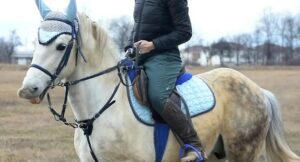
Riding a horse can be a fun experience. Make sure you know how to mount, steer, and signal your horse to move properly. Also, you must know how to train your horse and do groundwork with them before riding! Groundwork is the most important thing about riding horses and you must do it every time before riding your horse. Groundwork helps calm your horse and lets your horse know that you’re the boss before you get on them!
Laying the Groundwork for Mounting and Sitting
Mount Your Horse The first thing you’ll want to do when riding a horse is to do some groundwork. You don’t need to do heaps and make your horse tired, but you only need to do a little bit of groundwork! The next thing you will want to do is mount your horse correctly! Many people are intimidated by the idea of mounting a horse but if you stay calm it should be fun and easy.
- If you’re a first time rider, it’s not a bad idea to use a mounting block. This is a small wooden structure that you can use to stand on in order to mount the horse. [1]You should also ask someone to hold the horse’s head as you mount. #*Mount the horse from its left near side. Place your left foot in the left stirrup and launch your body up and over. Next, lift the right leg gently over the horse’s back and insert your right foot into the right stirrup.
- Select a well-trained horse if you’re a beginner. Horses that are younger or poorly trained may shift and move during mounting. Choose an older horse with a reputation for being calm and cooperative during rides.
- If someone doesn’t hold the horse’s head as you mount, you should hold the reins tightly in your left hand, but not so tightly that the horse backs away from the pressure
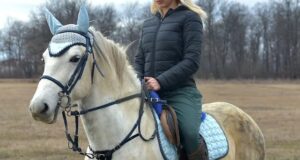
Position yourself for balance. Once in the saddle, take a moment to make sure you’re in the proper position for balance. Keep your back straight. Keep in mind when you ride a horse you should be able to draw a straight line through your ear, shoulder, hip, and heel. Keep your shoulders even and straight as well, with the bulk of your weight resting on your seat bones in your buttocks.
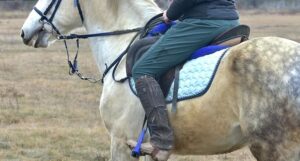
Get your legs in the right position. Once you feel securely balanced, get your legs into the proper position. This can be particularly difficult for beginning riders so take time to make sure your legs are positioned properly. Keep your heels right under your hips.
- Your legs should be turned inward. Many beginning riders have their legs turned outward, as this can feel more natural, with their knees sticking out. Remember, you’re sort of hugging the horse with your legs. You shouldn’t squeeze the horse too tightly, but have your legs curved inwards towards the horse.
- Your toes should rest higher than your heels. An easy stretch or practice for this is to stand on something higher than the ground or even a staircase and push your heels down keeping the balls of your feet on the staircase.
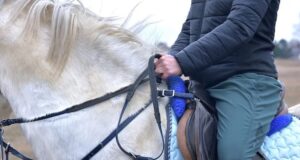
Hold the reins properly. Once your legs are in the right position, make sure you’re holding the reins properly. How you hold the reins depends on whether you’re riding English or Western.
- For English style, make a fist and then pass the reins through the fist so the loop of the reins faces upward. Then, remove both your pinky fingers from the fist and place them on the outside of the reins. Place your thumbs on top of the reins, securing them in place.
- In Western, the reins do not form a loop. The western bridle has reins that are knotted at the top. Keep the reins loose at all times and hold them in two fists.